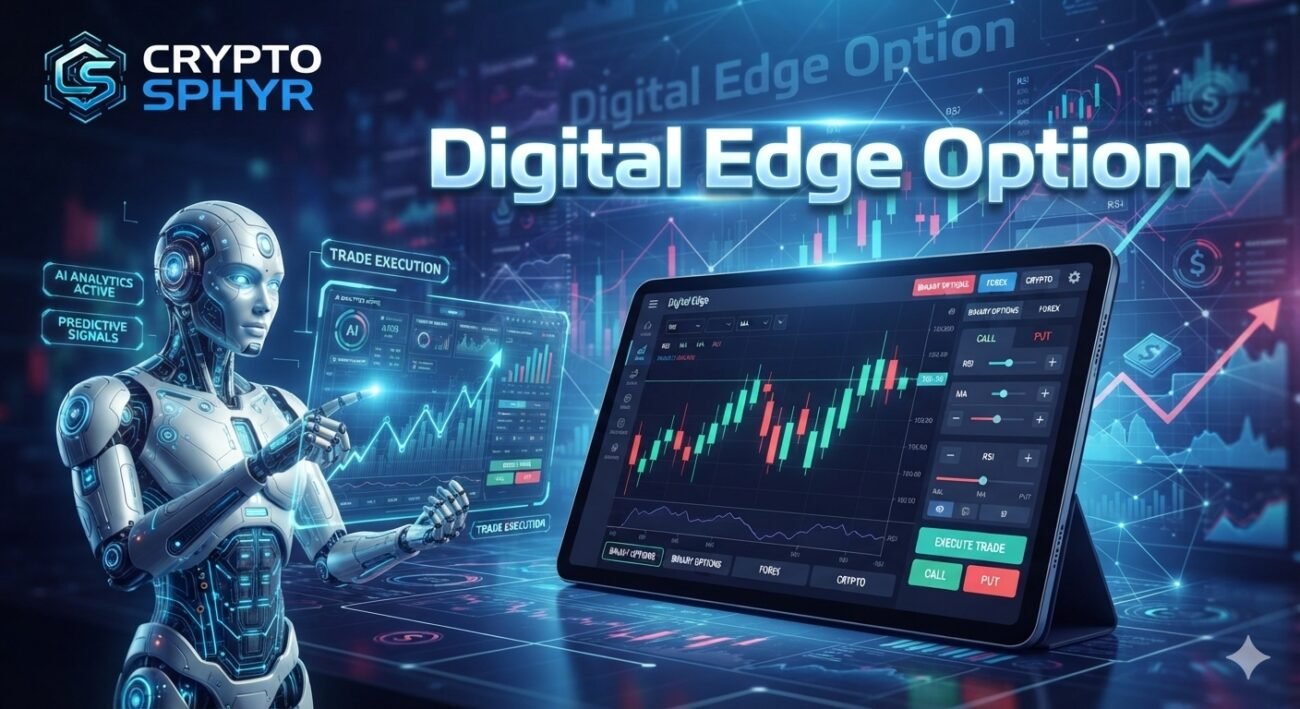
The cryptocurrency market is an unrelenting ecosystem. Operating twenty-four hours a day, seven days a week, and spanning across a fragmented landscape of global exchanges, it presents a unique challenge for the modern investor. The sheer velocity of price movements, driven by macroeconomic factors, regulatory news, and decentralized finance (DeFi) innovations, makes manual tracking nearly impossible for retail traders. In this highly competitive environment, technological leverage is no longer a luxury; it is a fundamental requirement. Enter Digital Edge Option, an algorithmic, artificial intelligence trading platform designed to bridge the gap between institutional-grade quantitative analysis and the everyday retail crypto trader.
This comprehensive analysis delves deep into the architecture, functionalities, cost structures, and real-world viability of Digital Edge Option. By dissecting its core mechanics, evaluating its asset coverage, and critically examining its risk management tools, we aim to provide a transparent, sophisticated look at whether this platform truly lives up to its bold market presence.
The Paradigm Shift: From Manual Charting to AI-Assisted Execution
To understand the value proposition of Digital Edge Option, one must first understand the evolutionary trajectory of digital asset trading. In the early days of Bitcoin, market participants relied on rudimentary order books and basic technical analysis. Traders would manually draw trendlines, calculate Fibonacci retracements, and monitor moving averages. However, human traders suffer from inherent limitations: fatigue, emotional biases, and the inability to process vast datasets simultaneously.
The introduction of algorithmic trading fundamentally altered this landscape. High-frequency trading (HFT) firms deployed bots that could execute thousands of orders in fractions of a second. For years, this level of technological sophistication was restricted to those with massive capital and proprietary software. Digital Edge Option aims to democratize this technology. It packages complex algorithmic models into a web-based, user-friendly interface.
The platform utilizes advanced data scraping techniques, ingesting historical price action, real-time order book depth, and momentum indicators. By synthesizing this data, the artificial intelligence attempts to identify micro-trends and breakout patterns before they become fully apparent to the broader market. It does not predict the future; rather, it calculates probabilities based on historical precedents and current market liquidity.
Core Mechanics: Under the Hood of Digital Edge Option
How does the platform actually function when you initiate a trading session? The marketing materials heavily promote “AI-powered market evaluation,” but what does this mean in practical terms?
1. Data Ingestion and Processing
The foundation of any trading bot is data. Digital Edge Option continuously streams live market data from various crypto liquidity providers. It looks at volume spikes, order book imbalances, and price action across multiple timeframes (from one-minute charts to daily candles). It also factors in momentum indicators such as the Relative Strength Index (RSI) and Moving Average Convergence Divergence (MACD) to determine whether an asset is overbought or oversold.
2. Signal Generation
Once the data is processed, the algorithmic engine applies its pre-defined logical conditions. If a specific cryptocurrency meets the criteria for a high-probability setup, the system generates a “signal.” In manual mode, this signal is pushed to the user’s dashboard as a suggestion—an alert highlighting a potential entry point, suggested stop-loss, and target take-profit level.
3. Automated Trade Execution
For those who opt for the fully automated mode, the platform bypasses the manual approval process. The moment the algorithm generates a signal, the software communicates directly via API (Application Programming Interface) with the partnered broker to execute the trade instantly. This eliminates the latency caused by human hesitation and ensures the trade is entered exactly at the calculated price point, minimizing slippage.
4. Continuous Portfolio Monitoring
Once a position is live, the algorithm doesn’t simply walk away. It actively manages the trade. If market volatility spikes due to an unexpected news event, the system can dynamically adjust trailing stops or exit the position entirely to preserve capital, provided the user has configured the software to allow such autonomous adjustments.
The Broker Network: The Crucial Execution Layer
One of the most widely misunderstood aspects of algorithmic trading platforms is where the actual money resides. Digital Edge Option is a software interface—a highly sophisticated analytical tool. It is not an exchange, a bank, or a custody provider.
To execute trades, the platform integrates with a network of regulated third-party brokers. When you register and deposit funds, your capital is actually held in an account with one of these partnered brokerages.
Why the Broker Matters
-
Liquidity Provision: Brokers provide the liquidity necessary to fill orders instantly. When the AI decides it is time to buy Solana or sell Bitcoin, the broker matches that order in the market.
-
Leverage and Margin: Brokers offer the margin facilities that allow traders to control larger positions with smaller capital outlays.
-
Security and Regulation: Reputable brokers operate under strict financial regulations, offering a layer of consumer protection, segregated client accounts, and robust cybersecurity measures.
During periods of extreme market duress—such as flash crashes or massive liquidation cascades—the assigned broker is responsible for applying risk controls, processing margin calls, and ensuring that trade execution remains as fluid as possible.
Unpacking the Financials: The $250 Minimum Deposit and Fee Structure
A critical factor in evaluating any trading software is the cost of doing business. The crypto ecosystem is notorious for hidden fees, exorbitant withdrawal charges, and complex tier systems. Digital Edge Option takes a relatively straightforward approach, though it requires careful examination.
The $250 Baseline Capital
The platform mandates a minimum initial deposit of $250. It is crucial to understand that this is not a subscription fee, a software license cost, or a registration charge. This $250 is your working trading capital. It is the fiat currency or cryptocurrency that will be utilized to open market positions.
Why $250? In algorithmic trading, the software needs sufficient margin to operate effectively. If the capital pool is too small, a single losing trade could trigger a margin call, liquidating the account. A $250 baseline allows the algorithm to practice proper position sizing—for example, risking only 2% to 5% of the total account balance on any single trade, allowing the account to weather the inevitable drawdowns that occur in active trading.
The “Zero Fee” Nuance
Digital Edge Option heavily markets its “zero platform fee” structure. There are no monthly subscriptions or direct software usage charges. However, trading is never entirely free. The costs are absorbed through the broker execution layer.
-
Bid-Ask Spreads: Whenever a trade is placed, there is a tiny difference between the buy price and the sell price. This spread is how the broker makes its money. While the platform itself isn’t charging you, the spread acts as an indirect cost on every transaction.
-
Overnight Financing (Swap Fees): Crypto is a 24/7 market. If you are trading derivatives or using margin, holding a position open indefinitely incurs overnight funding charges.
-
Withdrawal Nuances: While Digital Edge Option facilitates payouts quickly, users must always be aware of potential banking or blockchain network fees associated with moving capital in and out of the broker account.
Understanding this economic reality is vital for long-term profitability. High-frequency algorithms that place dozens of trades a day will accumulate significant spread costs. Traders must ensure that the algorithm’s profit targets comfortably exceed these micro-transaction costs.
Asset Diversity: A Comprehensive Look at Supported Cryptocurrencies
A robust trading algorithm is only as good as the markets it can access. Cryptocurrency is a highly heterogeneous asset class. Bitcoin trades very differently than a low-cap DeFi token. Digital Edge Option provides access to a broad spectrum of digital assets, allowing for extensive portfolio diversification and strategy optimization.
The Heavyweights: Bitcoin (BTC) and Ethereum (ETH)
Bitcoin is the undisputed king of liquidity. It is the macroeconomic indicator for the entire crypto space. The AI algorithms on Digital Edge Option utilize Bitcoin for stable, trend-following strategies. Because BTC has massive institutional backing and high liquidity, order execution is incredibly precise, and slippage is minimal. Ethereum introduces the dynamic of smart contract utility and network congestion (gas fees). ETH often acts as a leveraged play on Bitcoin—when Bitcoin moves up, Ethereum frequently follows with greater percentage gains, offering the algorithm lucrative volatility pockets.
The High-Throughput Challengers: Solana (SOL) and Cardano (ADA)
Solana’s architecture allows for blazing-fast transactions, making it a favorite for active trading. Its price action is notoriously volatile, characterized by sharp rallies and steep corrections. Digital Edge Option’s momentum indicators are well-suited to capture these aggressive swings. Cardano offers a slower, more methodical market rhythm, appealing to algorithms programmed for long-term support and resistance trading.
The Ecosystem Tokens: Binance Coin (BNB) and Ripple (XRP)
BNB is heavily tied to the volume and success of the world’s largest exchange ecosystem. Its tokenomics, including periodic coin burns, create unique supply-side shocks that the AI can anticipate and trade against. XRP, designed for cross-border banking settlements, frequently decouples from the rest of the market based on regulatory news, providing the algorithm with uncorrelated trading opportunities to hedge the broader portfolio.
The Legacy Assets and Meme Culture: Litecoin (LTC), Bitcoin Cash (BCH), and Dogecoin (DOGE)
Litecoin and Bitcoin Cash provide excellent historical data for the AI to analyze, as they have survived multiple bear markets. They often experience delayed rallies after Bitcoin peaks, creating predictable cyclical trades. Dogecoin, driven entirely by social sentiment and retail momentum, represents the ultimate volatility play. The algorithm can monitor social volume and volume spikes to catch explosive upward movements before they fully materialize.
The Safe Haven: Tether (USDT)
The inclusion of USDT (and other stablecoins) is paramount. When the algorithm detects a massive market downturn or a sudden crash in liquidity, it can swiftly liquidate volatile crypto assets into stablecoins, preserving the portfolio’s fiat value until the market stabilizes.
Registration and Onboarding: A Step-by-Step Walkthrough
One of the most significant barriers to entry in decentralized finance is the steep technical learning curve involving hardware wallets, seed phrases, and complex exchange interfaces. Digital Edge Option bypasses this by offering a streamlined, Web2-style onboarding process that takes minutes, not hours.
Phase 1: Account Initiation
The journey begins on the official web portal. The system asks only for essential data points to establish your digital identity: First Name, Last Name, Email Address, Mobile Number, and Country of Residence. (Note: The platform restricts access in certain jurisdictions, such as Cyprus, Israel, and Iran, due to stringent local financial regulations).
Phase 2: Secure Verification
Upon submitting the initial form, an activation link is dispatched to your inbox. This confirms email ownership. Simultaneously, you may be contacted by a representative from the assigned partner broker. This step is a standard Anti-Money Laundering (AML) and Know Your Customer (KYC) procedure required by international law, ensuring the ecosystem remains secure and compliant.
Phase 3: Capital Injection
Once verified, the user is prompted to fund the account. The platform integrates with traditional financial rails, accepting Debit Cards, Credit Cards, and direct Bank Transfers, as well as digital wallets like PayPal and Skrill. Funding is typically instantaneous for card payments, allowing immediate access to the trading software.
Phase 4: Strategy Configuration
This is where the user takes control. Before activating the AI, you must define the parameters. What is your risk appetite? Which specific cryptocurrencies do you want the bot to trade? Do you want to approve every trade manually, or do you want to enable fully automated execution? These choices dictate the behavior of the algorithm going forward.
The Virtual Sandbox: Mastering the Demo Account
Perhaps the most valuable feature offered by Digital Edge Option is its comprehensive Demo Account. The psychological leap from reading about crypto trading to watching live money fluctuate on a screen is massive. The demo environment serves as a crucial bridge.
Why You Must Never Skip the Demo
Many novice traders, fueled by adrenaline and the desire for quick returns, bypass the demo account and jump straight into live trading. This is a critical error. The demo account replicates real-time market conditions using simulated funds. It uses actual order book data, real-time price feeds, and accurate slippage models.
Testing AI Configurations
The demo is your laboratory. If you set the algorithm to “Aggressive Mode” and authorize it to trade Dogecoin and Solana, the demo account will show you exactly what that looks like over a 24-hour period. You might find that the volatility is too stressful or the drawdowns are too deep. You can then tweak the parameters, perhaps restricting the bot to Bitcoin and Ethereum with a “Conservative” risk profile, and run the test again.
Building Emotional Resilience
Trading is 80% psychology and 20% strategy. Watching a simulated account dip by $50 teaches you how the algorithm recovers without the panic of losing real money. It builds trust in the system’s logic, ensuring that when you do switch to live funds, you do not prematurely intervene and ruin a trade that the AI was successfully managing.
Risk Management Protocol: Engineering Your Safety Net
Artificial intelligence is powerful, but it is not infallible. Algorithms operate based on probabilities, and in the crypto market, black swan events—unexpected occurrences with massive impact—happen regularly. Effective use of Digital Edge Option requires a deep understanding of its built-in risk management tools.
The Stop-Loss Order: Your Ultimate Shield
A stop-loss is an automated instruction to the broker to sell an asset immediately if its price drops to a specific level. If the AI buys Bitcoin at $60,000, you can configure a strict stop-loss at $58,000. If the market suddenly crashes, the system will instantly liquidate the position, capping your loss at a manageable level. Digital Edge Option allows users to customize these limits tightly.
The Take-Profit Target: Securing the Bag
Greed is the enemy of the crypto trader. Often, an asset will spike in value, only to retrace completely minutes later. A take-profit order ensures that when a trade hits a designated profit margin (e.g., 5%), the system automatically closes the position and locks in the gains. The AI excels at hitting these targets with surgical precision before human traders even realize the price has peaked.
Position Sizing and Diversification
A golden rule of trading is never to risk your entire portfolio on a single trade. Digital Edge Option’s interface allows users to dictate maximum position sizes. By configuring the bot to never deploy more than 10% of the total balance on any single asset, you ensure that even if a specific coin collapses, your overall portfolio survives. Furthermore, by selecting a diverse basket of assets (e.g., mixing large-cap coins like BTC with high-volatility tokens like SOL), you spread your risk across different market sectors.
Security Infrastructure and Trustworthiness
In an industry plagued by high-profile hacks, rug pulls, and collapsed exchanges, security cannot be an afterthought. While no digital platform can guarantee 100% immunity, Digital Edge Option has implemented several layers of defense.
Broker Regulation
As previously noted, the platform does not hold your funds; regulated brokers do. These brokers are typically subject to stringent oversight by financial authorities in their respective jurisdictions. This means they are required to hold client capital in segregated accounts, entirely separate from the company’s operational funds.
Data Encryption and Privacy
The web interface utilizes advanced SSL (Secure Socket Layer) encryption. When you input your personal details or payment information, the data is encrypted before it travels across the network, protecting it from interception by malicious actors.
The Reality of “Scam” Accusations
If you search for any algorithmic trading bot online, you will find polarized reviews. Digital Edge Option currently boasts an early community rating of 4.6/5, indicating a strong positive reception. However, it is vital to distinguish between a platform being a “scam” and a user practicing poor risk management. A functioning AI tool that executes trades flawlessly can still lose money if the user configures it to buy highly volatile assets during a bear market with no stop-losses. The tool is legitimate; the responsibility for the financial outcome ultimately rests on the operator’s settings.
Strengths and Weaknesses: An Unbiased Evaluation
To provide a holistic view, we must weigh the platform’s distinct advantages against its inherent limitations.
The Distinct Advantages
-
Accessibility for Beginners: The user interface is remarkably clean. It strips away the intimidating technical jargon found on professional terminals, making algorithmic trading accessible to absolute beginners.
-
Time Efficiency: Manual trading requires staring at charts for hours on end. Digital Edge Option reclaims your time, actively scanning the markets while you sleep, work, or travel.
-
Emotionless Execution: The AI does not feel fear during a market crash, nor does it feel the euphoric greed of a bull run. It executes purely on mathematical logic, eliminating the most common cause of retail trading losses.
-
Swift Liquidity Access: The reported 24-hour withdrawal processing time is highly competitive, ensuring traders can access their profits efficiently.
-
Robust Asset Roster: The ability to trade a wide variety of cryptocurrencies ensures that the AI can always find a market in motion, regardless of Bitcoin’s immediate price action.
The Notable Drawbacks
-
Bold Marketing Claims: The advertising surrounding the platform often leans heavily into “high return opportunities.” While profitable trading is possible, continuous high returns are never guaranteed in crypto. Users must look past the marketing gloss.
-
Hidden Broker Costs: The “zero fee” marketing can mislead newcomers who fail to account for the broker bid-ask spreads, which will slowly eat into profit margins if the bot is hyper-active.
-
Geographical Limitations: Regulatory hurdles prevent the platform from serving citizens in several specific regions, limiting its global footprint.
-
The Illusion of Passivity: Automated trading is not “set it and forget it.” Market conditions change. A strategy that worked in a highly volatile week may bleed capital during a sideways, low-liquidity week. Users must actively manage their AI configurations.
The Psychological Edge of Automation
To truly grasp the value of Digital Edge Option, one must examine the psychology of the retail investor. The human brain is hardwired to make terrible financial decisions in highly stressful environments.
FOMO (Fear of Missing Out): When a coin pumps 30% in an hour, humans instinctively buy the top, terrified of missing the rally. The AI, however, looks at the overbought RSI and mathematically calculates that a correction is imminent, either holding its position or executing a short sell.
FUD (Fear, Uncertainty, and Doubt): When the market bleeds and red candles dominate the screen, humans panic sell at the bottom, locking in devastating losses. The AI analyzes historical support levels and liquidity pools, identifying the crash as an optimal, high-probability buying opportunity.
By delegating the execution to a machine, you separate your emotional responses from your financial capital. You transition from a reactive gambler to a proactive manager of algorithmic systems.
Common Pitfalls and How to Avoid Them
Even with state-of-the-art software, users can sabotage their own success. Here are the most common mistakes made by new users on Digital Edge Option, and how to avoid them:
1. The Over-Leverage Trap
Because the partnered brokers offer margin, it is tempting to use leverage to amplify potential gains. However, leverage equally amplifies losses. A 10x leveraged position means a mere 10% drop in the asset’s price will entirely liquidate your capital. Rule: Stick to standard spot trading or extremely low leverage (2x-3x) until you have a deep understanding of the algorithm’s win rate.
2. Ignoring Macro-Economic News
While the AI reads technical data flawlessly, it cannot predict the outcome of a sudden regulatory ban or a major central bank interest rate decision. If a massive, market-altering news event is scheduled, the smartest move is often to pause the automated trading, step aside, and let the volatility settle.
3. Premature Intervention
A common scenario: A user sets the AI to auto-trade. The bot enters a position, and the market immediately dips 2%. The user panics, overrides the AI, and manually closes the trade for a loss. An hour later, the market recovers and hits what would have been the AI’s take-profit target. Rule: If you set a stop-loss and a take-profit, let the trade play out. Trust the parameters you set.
4. Overcapitalizing Too Quickly
Experiencing a profitable first week in the demo account (or with the initial $250) often leads to overconfidence. Users will suddenly deposit $5,000 without understanding how larger positions suffer from slippage. Rule: Scale your capital slowly. Increase your investment in small increments only after months of consistent, verified results.
Is Digital Edge Option Right for You? A User Profile Analysis
The platform is highly versatile, but it appeals differently depending on your experience level in the cryptocurrency space.
The Complete Beginner
For someone who has never placed a crypto trade, Digital Edge Option is an excellent gateway. The elimination of complex charting tools in favor of a clean, simplified dashboard prevents analysis paralysis. The mandatory demo account serves as a risk-free educational hub. If you are a beginner, your goal should not be immediate wealth; it should be learning how market cycles operate while risking only the $250 minimum.
The Intermediate Trader
If you have been trading for a year or two, you likely understand support/resistance, trendlines, and basic indicators. You also know how exhausting it is to monitor the market constantly. For you, the platform serves as an execution assistant. You can use your own knowledge to select the optimal assets and risk profiles, and let the AI handle the tedious work of exact entry and exit timing.
The Seasoned Professional
For highly experienced traders, the platform acts as a secondary quantitative tool. A pro might use their primary exchange for complex derivative strategies while allocating a portion of their portfolio to Digital Edge Option to capture automated, high-frequency scalping opportunities that a human simply cannot execute fast enough.
Frequently Asked Questions (FAQs)
1. What is the absolute minimum I need to start trading?
The required baseline deposit to activate a live trading account is $250. This money remains yours and acts as your initial liquidity pool to execute trades in the market.
2. Does Digital Edge Option charge a monthly subscription fee?
No. The platform software is provided without monthly licensing fees or registration charges. However, standard trading costs such as broker bid-ask spreads and potential overnight holding fees will apply directly to your trades.
3. Do I need to be a coding expert to use the AI?
Absolutely not. The system is entirely “no-code.” The interface relies on simple sliders, toggles, and drop-down menus to configure risk levels and select crypto assets.
4. Can I use the platform on my mobile phone?
Yes. While it does not require a dedicated app download from a centralized app store, the web portal is fully optimized for mobile smartphone browsers, allowing you to monitor and adjust your automated portfolio on the go.
5. How quickly can I withdraw my funds?
According to platform specifications, withdrawal requests are typically processed and cleared within 24 hours, though exact timelines can vary depending on the chosen withdrawal method (e.g., bank transfer vs. digital wallet) and standard broker verification checks.
6. Is automated trading totally risk-free?
No trading is risk-free. Artificial intelligence reduces the workload and eliminates emotional trading errors, but it cannot prevent market crashes or guarantee profits. The final responsibility for risk management and potential financial loss rests entirely with the user.
7. Which cryptocurrencies can the AI trade?
The platform supports a wide array of major digital assets through its broker partners, including Bitcoin (BTC), Ethereum (ETH), Solana (SOL), Binance Coin (BNB), Tether (USDT), Dogecoin (DOGE), Litecoin (LTC), Ripple (XRP), and Cardano (ADA), among others.
The Final Verdict: Navigating the Edge of Innovation
The cryptocurrency arena is evolving rapidly, leaving those who rely solely on manual, emotion-driven trading at a severe disadvantage. Digital Edge Option enters this space as a highly competent, user-centric solution that successfully democratizes algorithmic trading.
By offering a seamless onboarding process, a reasonably low entry barrier of $250, and a powerful, mandatory demo environment, it sets its users up for informed, strategic participation in the digital asset market. The underlying artificial intelligence is capable of processing complex market data and executing trades with a speed and precision that human hands simply cannot replicate. Furthermore, its integration with regulated brokerages ensures that security, liquidity, and rapid execution remain a priority.
However, a mature approach is essential. The marketing promises of “high returns” must be heavily contextualized. Digital Edge Option is a sophisticated power tool, not a magical money-printing machine. Success on this platform requires the user to actively engage with the software—setting strict stop-losses, taking profits logically, and continuously adjusting risk parameters to match the ever-shifting macroeconomic climate.
If you approach Digital Edge Option with a conservative mindset, utilize the demo account rigorously, and respect the inherent volatility of the cryptocurrency markets, it stands as an exceptionally valuable asset in your trading arsenal. It removes the emotional exhaustion of chart-watching and replaces it with cold, calculated, machine-driven logic. For the modern digital investor, that edge might be exactly what is required to survive and thrive.
